Did you know more than 70% of Amazon shoppers never scroll past the first page of results? That means if your product isn’t showing up there, you’re practically invisible. Amazon PPC marketing puts you on page one, but it’s not as simple as paying the highest price for an ad.
Every single search on Amazon triggers an instant auction where your ad competes against others. Your bid matters, but so does how relevant and strong your product listing is. Here’s a more detailed guide on how this works.
What is PPC on Amazon?
Amazon PPC is Amazon’s advertising system that allows sellers to bid on keywords so their products appear in search results or on product detail pages. Instead of paying upfront, you only pay when someone clicks your ad.
PPC ads are one of the most effective ways to boost visibility, get sales, and improve organic ranking. When your ad generates sales, Amazon’s algorithm sees that your product is relevant and rewards you with higher organic placement too.
The Three Main Types of Amazon PPC Ads –
Sponsored Products
This is the most widely used ad format on Amazon and for good reason. Sponsored Products account for around 70–80% of all Amazon ad spend. They look almost identical to a regular product listing, except for the small “Sponsored” tag. You’ll see them in search results, product detail pages, and sometimes even within carousels like “Customers also bought.”
Sponsored Brands
Sponsored Brands ads are the big banner-style ads you see at the very top of search results. They feature your brand logo, a custom headline, and up to three of your products. They always appear in premium placements, usually at the very top of search results, sometimes on the left side, and occasionally at the bottom of a page.
Sponsored Brands are less about immediate clicks and more about brand recognition. According to Amazon, they can increase brand awareness by up to 24% compared to running only Sponsored Products. That’s because they let you highlight multiple products together instead of just one.
Sponsored Display
Sponsored Display ads are unique because they don’t just show up on Amazon. They also appear on third-party websites and apps. They use Amazon’s shopper data to retarget customers who looked at your product (or a competitor’s) but didn’t buy.
Nearly 95% of visitors to a product page don’t purchase on their first visit. Sponsored Display gives you a way to bring those shoppers back.
Sponsored Display is one of the fastest-growing ad formats on Amazon. In fact, Amazon reported that ad revenue from formats like Sponsored Display grew by over 20% year-over-year in 2023.
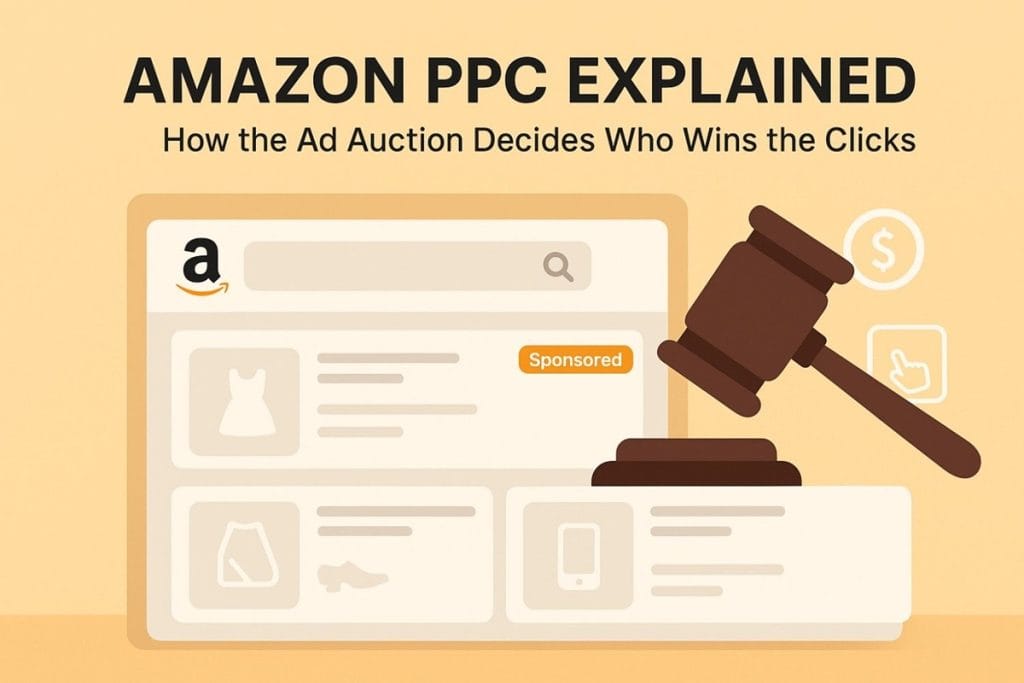
How the Amazon PPC Auction Works
Amazon PPC auction is not like a traditional auction where the highest bidder always wins. Amazon’s auction runs in real time every time a shopper searches. Here’s how it actually works:
Step 1: A Shopper Enters a Search Term
When someone types a keyword into the search bar, Amazon instantly identifies all advertisers bidding on that keyword or close variations. The auction starts right there. It happens in milliseconds, long before the shopper even sees the results page.
Every single search triggers a new auction. That means if 1,000 people search for “garlic press” in one day, the auction runs 1,000 times. Your ad’s performance is decided every single time.
Step 2: Amazon Runs the Auction
All sellers who bid on that keyword enter the auction. The number of competitors depends on the keyword. Highly competitive terms can have hundreds of advertisers. Niche long-tail keywords may only have a handful.
Step 3: Ranking Ads by Bid + Relevance
The common myth is that the highest bid always wins. That’s not true. Amazon looks at two main things together:
- Bid Amount: How much you’re willing to pay per click.
- Relevance and Quality: How closely your listing matches what the shopper is searching for, plus how your ads have performed in the past.
For example, if you’re bidding on “stainless steel garlic press” but your listing title says “plastic garlic press,” Amazon sees you as less relevant. Even if you bid higher, you can lose to someone with a lower bid but a more relevant, better-optimized listing.
Amazon also weighs performance metrics like CTR and conversion rate. If your ad gets clicked often and turns clicks into sales, Amazon will give you better placements at lower costs because your ad is more likely to satisfy the shopper.
Step 4: Winners Get Ad Placement
The highest-ranking ads win placements in search results or on product detail pages. The best spots, like the very top of page one, usually go to the ads with the strongest combination of bid, relevance, and performance history. These spots often get up to 3x higher click-through rates than ads at the bottom of the page.
However, that doesn’t mean lower positions are useless. Ads in the middle of the page or on product detail pages can still convert well at a lower cost, especially if you’re targeting long-tail keywords where competition is lighter.
Step 5: The Second-Price Auction Rule
Amazon uses a second-price auction model, similar to Google Ads. This means you don’t pay your full bid. Instead, you pay just enough to beat the second-highest bidder.
Here’s an example:
- If you bid $2.00 per click and the next highest bid is $1.50, you’ll pay around $1.51.
This system is designed to keep bids competitive but fair. Still, sellers need to be careful. If you consistently overbid without optimizing relevance, you’ll end up with a high ACoS and shrinking profit margins.
Factors That Influence the Auction
Amazon wants ads that shoppers will actually click and buy from. Here are key factors Amazon looks at:
- Click-Through Rate (CTR): How often people click your ad when they see it.
- Conversion Rate (CVR): How often clicks turn into purchases.
- Listing Quality: Titles, bullet points, descriptions, and images that match keywords and attract buyers.
- Ad History: Past performance of your ad campaigns.
- Relevance to the Keyword: How closely your product matches what the shopper typed.
How to Improve Your Chances of Winning
If you want to do well in the auction, focus on both your bid strategy and your listing quality.
- Target relevant, high-intent keywords.
- Optimize your listings with clear titles, detailed bullet points, and high-quality images. Make sure your content matches the keywords you target.
- Start with auto campaigns and use the data to refine manual campaigns.
- Monitor performance and increase bids for high-converting keywords while lowering or pausing weak ones.
- Watch ACoS, CTR, and conversion rates to guide decisions.
Summary
Amazon PPC advertising is a competitive system where bid amount, relevance, and performance all decide whether your ad shows up in front of buyers. The second-price auction keeps costs fair, but winning consistently requires smart keyword choices, optimized listings, and constant campaign adjustments.
Looking for expert Amazon PPC management? At Enso Brands, we manage every part of Amazon PPC for you from keyword research to bid optimization to ad tracking. Contact us today to see how we can help your brand win on Amazon.