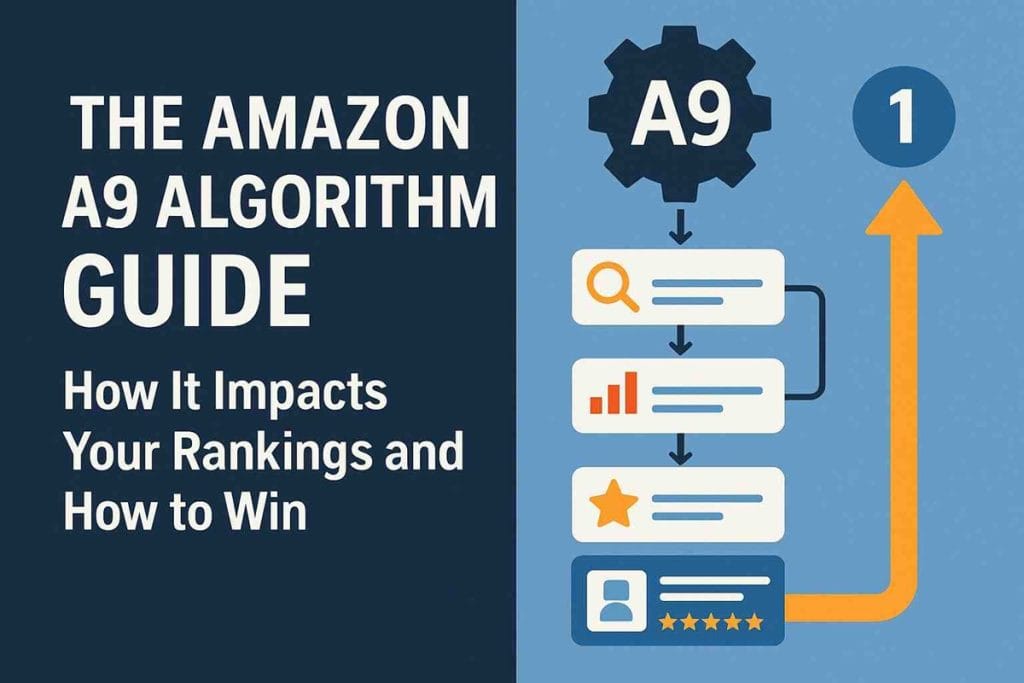
Every time a shopper types a search query into Amazon, the A9 algorithm decides which products appear and in what order. Page one of Amazon search results captures the overwhelming majority of clicks and sales. Page two and beyond rarely get seen. Understanding how A9 works is the foundation of every Amazon SEO strategy.
This guide explains the core signals Amazon’s A9 algorithm uses to rank products, how those signals have evolved through 2025 and into 2026, and the specific actions you can take to improve your organic position.
What Is the Amazon A9 Algorithm?
A9 is Amazon’s product search algorithm, named after A9.com, the Amazon subsidiary that developed it. It is a relevance and performance algorithm: it ranks products based on how relevant they are to the search query AND how likely they are to convert into a sale. Unlike Google’s algorithm, which optimizes for information quality, A9 optimizes for purchase likelihood.
Amazon’s goal is to show shoppers the products they are most likely to buy. A product that ranks well but does not convert tells Amazon’s system that it is not a good match for that query, and it will slip in rankings over time. This creates a self-reinforcing system: products with high conversion rates earn better placements, which generates more traffic, which generates more sales.
The Two Pillars of A9 Ranking: Relevance and Performance
Pillar 1: Relevance Signals
Relevance signals tell the algorithm what your product is and whether it matches a given search query. These are the elements you control through listing optimization.
- Product title: The highest-weighted relevance field. Amazon’s algorithm reads the title to determine primary keyword relevance. Include your most important keywords in the first 60 to 80 characters, because this is what appears in search results on mobile and desktop.
- Bullet points: Secondary keyword coverage. Use bullets to include important keywords naturally while communicating product benefits. Do not keyword-stuff at the expense of readability.
- Product description: Lower weight than title and bullets, but still indexed. For Brand Registry sellers, A+ Content replaces the standard description but also contributes to keyword indexing.
- Backend search terms: Hidden from shoppers but indexed by Amazon. Use this field to include keyword variations, synonyms, misspellings, and related terms that do not fit naturally in visible copy. Maximum 250 bytes.
- Category and subcategory: Correct categorization affects which search queries your listing appears for. Miscategorization is a common and underdiagnosed ranking issue.
Pillar 2: Performance Signals
Performance signals tell the algorithm how well your product satisfies shoppers who see it. These are harder to optimize directly but are the key differentiator for competitive keywords.
- Sales velocity: Your recent sales rate is one of the strongest ranking signals. More sales = higher ranking = more sales. This is why launching a new product with aggressive pricing or advertising to generate initial velocity is a standard Amazon SEO tactic.
- Conversion rate: The percentage of page views that result in a purchase. Higher conversion tells A9 that your listing is a good match for the queries bringing traffic. Improve this by optimizing images, bullet points, pricing, and reviews.
- Click-through rate (CTR): How often shoppers click your listing when it appears in search results. CTR is influenced by your main image, title, star rating, price, and Prime badge. Low CTR signals a weak listing presentation.
- Reviews and ratings: Both the number of reviews and the average star rating are significant performance signals. A product with 200 reviews at 4.5 stars will consistently outrank a comparable product with 20 reviews at 4.7 stars in most scenarios.
- Price competitiveness: Amazon tracks prices relative to other sellers in the category. Products priced significantly above the category average may see ranking suppression.
How A9 Has Evolved: COSMO and AI-Driven Ranking
Amazon has been integrating machine learning and semantic understanding into its search system for several years. The COSMO (Common Sense Knowledge Graph for eCommerce) update and subsequent AI improvements have made the algorithm better at understanding shopper intent rather than just matching keywords.
Practical implications for sellers in 2026:
- Keyword stuffing is less effective than it was in 2019 to 2021. Natural language that communicates product benefits clearly tends to outperform lists of keywords with no connecting context.
- Use case signals matter. Amazon’s AI looks for contextual signals about who uses the product and in what situations. Include these explicitly in your copy.
- Amazon Rufus (the AI shopping assistant) now processes listing content to answer shopper questions. Listings written to directly answer common questions get recommended more often by Rufus. See our Amazon Rufus optimization guide for the full breakdown.
How to Improve Your A9 Rankings: A Practical Checklist
1. Conduct Thorough Keyword Research
Use Amazon’s own search bar autocomplete, Brand Analytics (if you have Brand Registry), and third-party tools like Helium 10 or Jungle Scout to identify all relevant keywords for your product. Group keywords by search volume and relevance priority. Your title should target the highest-volume, most relevant terms. Bullets and backend terms cover the long tail.
2. Optimize Your Title for the First 80 Characters
Put your most important keyword first, followed by brand name, key product attribute, and size or quantity. Amazon truncates titles in search results, so everything after character 80 may not be visible. Do not waste the first 80 characters on filler words.
3. Drive Early Sales Velocity on New Listings
New listings have no sales history. Until you build velocity, the algorithm has no performance signal to use. Run Sponsored Products campaigns immediately at launch to generate early sales. Consider a launch discount or coupon to improve conversion rate during the first 30 days. Early sales velocity creates a ranking foundation that compounds over time.
4. Improve Your Main Image CTR
Run a split test (Amazon offers A/B testing through Manage Your Experiments for Brand Registry sellers) on your main image to find the version with the highest CTR. A 10% improvement in CTR translates directly into more organic traffic without requiring any additional ranking improvement.
5. Build Reviews Systematically
Use the Amazon “Request a Review” feature for every order between 5 and 30 days post-delivery. Enroll new products in Amazon Vine to generate early, high-quality reviews. Monitor your star rating weekly. A drop from 4.5 to 4.2 stars can cause meaningful ranking regression for competitive keywords.
6. Keep Inventory In Stock
Going out of stock loses your ranking. Amazon deprioritizes or removes listings from search when inventory runs out. Recovering ranking after a stockout can take weeks. Use inventory forecasting to stay at least 30 days ahead on your best-selling SKUs, and increase that buffer ahead of Q4 and Prime Day.
The Role of Amazon PPC in A9 Rankings
Paid advertising on Amazon (Sponsored Products) and organic ranking are linked. When your ad generates a sale, that sale contributes to your sales velocity signal just like an organic sale does. This is why running PPC during a launch or during a ranking push accelerates organic ranking improvement, not just paid traffic.
The relationship between PPC and organic rank is not direct (paying more does not automatically boost organic position), but the sales generated by PPC feed into the performance signals A9 uses. This is the mechanism behind the “halo effect” that experienced sellers use to grow organic rank during promotional periods.
Frequently Asked Questions
What is the Amazon A9 algorithm?
The Amazon A9 algorithm is the search ranking system that determines which products appear in response to a shopper’s search query and in what order. It optimizes for purchase likelihood, using relevance signals (keyword match in title, bullets, backend fields) and performance signals (sales velocity, conversion rate, reviews) to rank products.
How do I rank higher on Amazon search?
Focus on the two pillars: relevance and performance. For relevance, optimize your title, bullet points, and backend keywords with high-volume, accurate search terms. For performance, improve your conversion rate through better images and copy, build reviews systematically, drive sales velocity at launch, and keep inventory consistently in stock.
Does Amazon PPC affect organic ranking?
Not directly, but indirectly through sales velocity. Sales generated by Sponsored Products ads contribute to your total sales velocity, which is an organic ranking signal. Running PPC during a product launch or ranking push accelerates organic ranking improvement because it generates the sales signal that A9 needs to evaluate your product’s performance.
How long does it take to rank on Amazon?
For new products in competitive categories, expect 60 to 90 days of consistent optimization and advertising to establish meaningful organic rank. In less competitive niches or for established listings receiving an SEO refresh, improvements can appear within 2 to 4 weeks. Ranking on Amazon is a continuous process, not a one-time setup.
Understanding the A9 algorithm is step one. Executing against it consistently is the work. Our Amazon SEO services cover keyword research, listing optimization, and ongoing rank tracking for brands that want professional execution. Learn more about how we combine SEO with our full-service account management for complete Amazon growth.