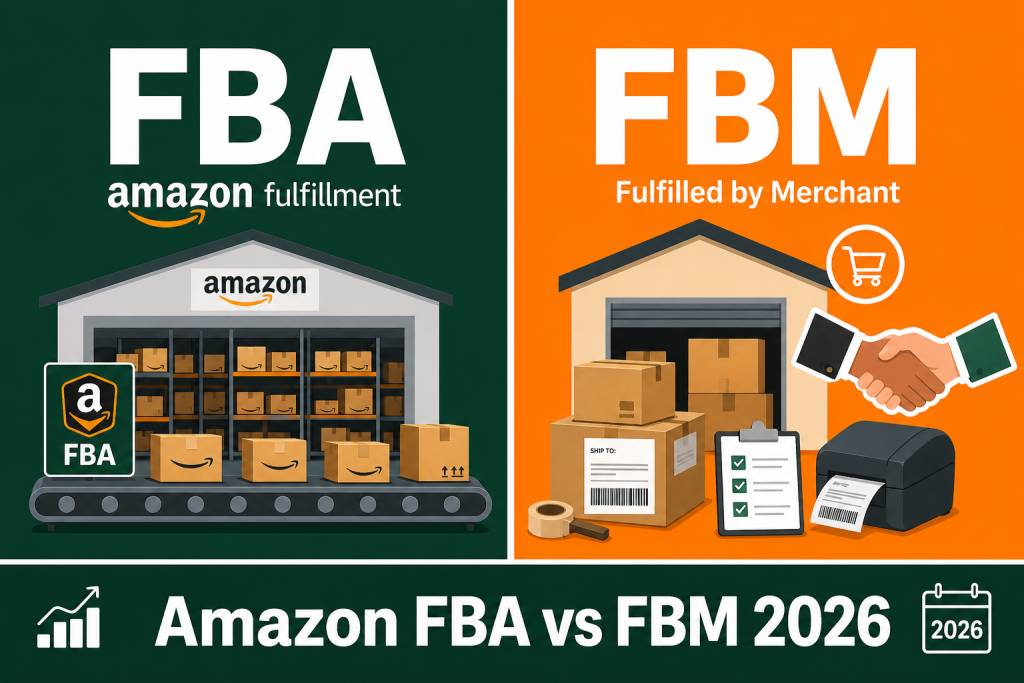
- Amazon FBA handles storage, packing, shipping, and customer service for a fee. FBM means you control all of that yourself.
- FBA typically costs $3.22 to $6.00+ in fulfillment fees per unit, plus monthly storage fees starting at $0.78 per cubic foot.
- FBA wins on Prime eligibility and hands-free operations. FBM wins on margins for heavy/oversized items and gives you direct customer relationships.
- Most serious sellers use a hybrid approach, running FBA for fast-moving SKUs and FBM as a backup or for slow-moving inventory.
If you are launching on Amazon or auditing your fulfillment strategy heading into 2026, the FBA vs FBM decision is one of the highest-leverage choices you will make. Get it right and you unlock Prime placement and operational simplicity. Get it wrong and fees quietly erode your margins while your competitors out-rank you in search.
This guide breaks down exactly how each model works, what it costs with real numbers, and how to decide which is right for your specific business. Whether you are selling lightweight supplements, heavy fitness equipment, or a mixed catalog, the framework below will give you a clear answer.
What Is Amazon FBA?
Fulfillment by Amazon (FBA) is Amazon’s logistics program where you ship your inventory to Amazon fulfillment centers and Amazon handles everything that happens after a customer clicks “Buy.” That includes picking and packing, shipping, tracking, customer service, and returns processing.
In exchange, Amazon charges a fulfillment fee per unit and a monthly storage fee based on how much cubic space your inventory occupies. Your products automatically qualify for Prime two-day (and often same-day) shipping, and the “Fulfilled by Amazon” badge appears on your listing, which has a measurable impact on conversion rates.
FBA accounts for more than 73% of third-party seller volume on Amazon, according to Marketplace Pulse data from 2025. The reason is simple: Amazon’s fulfillment network is hard to beat on speed and scale, and Prime eligibility directly affects where you rank in search results.
What FBA Handles for You
- Inbound shipping logistics (once your goods arrive at fulfillment centers)
- Storage and inventory management across Amazon’s network
- Pick, pack, and ship for every order
- Returns processing and customer refunds
- 24/7 Amazon customer service for fulfillment-related issues
What FBA Does Not Handle
- Manufacturing and sourcing
- Inbound freight from your supplier to Amazon
- Product quality issues or defect-related returns (your responsibility)
- Listing creation and optimization
- Advertising and marketing
What Is Amazon FBM?
Fulfillment by Merchant (FBM) means you store inventory at your own warehouse or a third-party logistics (3PL) provider, and you fulfill every order yourself when it comes in. Amazon acts purely as the sales channel. You handle packing, shipping carriers, tracking uploads, and customer communication around shipping.
FBM removes Amazon’s fulfillment fees from your cost structure, but you absorb warehouse rent, labor, packaging materials, and shipping carrier costs directly. For some product types and business models, this tradeoff is strongly in your favor. For others, it is a margin trap.
FBM also keeps your customer relationship one step closer. You control the unboxing experience, can include inserts, and handle returns on your own terms within Amazon’s policy framework. This is particularly valuable for sellers building a brand beyond Amazon.
Seller Fulfilled Prime (SFP)
A third option worth noting is Seller Fulfilled Prime (SFP), which lets FBM sellers earn the Prime badge if they meet strict performance requirements: 99% on-time delivery, a pre-fulfillment cancel rate below 0.5%, and use of approved shipping services. SFP is invitation-only and requires a proven track record. Most new sellers start with FBA or standard FBM before qualifying.
FBA vs FBM: Side-by-Side Comparison
| Factor | Amazon FBA | Amazon FBM |
|---|---|---|
| Fees / Cost | Fulfillment fee ($3.22 to $6.00+ per unit) + storage fee ($0.78/cu ft standard, $2.40/cu ft Oct-Dec) | No Amazon fulfillment fee; you pay warehouse, labor, and carrier costs directly |
| Storage | Amazon fulfillment centers; limits apply; aged inventory surcharges after 181 days | Your warehouse or 3PL; no Amazon storage limits or surcharges |
| Shipping Speed | 2-day Prime standard; same-day in many metro areas | Depends on your setup; typically 3 to 7 days without SFP |
| Prime Eligibility | Automatic with FBA enrollment | Only via Seller Fulfilled Prime (invite-only, strict requirements) |
| Returns | Amazon handles the full returns process; can result in unsellable inventory | You process returns; more control over disposition and refund timing |
| Control | Low; Amazon controls packaging, shipping methods, and customer contact | High; control over packaging, inserts, carrier selection, and communication |
| Best For | Lightweight, fast-moving products; sellers prioritizing scale and Prime placement | Heavy or oversized items; slow-moving SKUs; established logistics operations |
Cost and Fee Breakdown With Real Numbers
Understanding the actual numbers behind each model is essential for making the right choice. Here is a practical breakdown using real 2025 to 2026 Amazon fee data.
FBA Fees: What You Actually Pay
Fulfillment Fees (per unit, standard size):
- Small standard (under 4 oz): $3.22
- Large standard (6 to 12 oz): $4.61
- Large standard (1 to 2 lb): $5.29
- Large standard (2 to 3 lb): $5.58
- Large bulky (up to 30 lb): $9.61 to $12.99+
Monthly Inventory Storage Fees (per cubic foot):
- January through September (standard size): $0.78
- October through December (standard size): $2.40
- January through September (oversize): $0.56
- October through December (oversize): $1.40
Aged Inventory Surcharges: Units stored between 181 and 270 days incur a $0.50 per cubic foot surcharge. Units stored over 271 days jump to $1.50 per cubic foot on top of the standard storage fee. This is where slow-moving FBA inventory quietly destroys margins.
Referral Fees: These apply equally to FBA and FBM. Most categories charge 8% to 15% of the sale price. Apparel is 17%, and Amazon Device Accessories top out at 45%. Referral fees are separate from fulfillment fees.
Real-World FBA Example
Imagine you sell a supplement product (250g canister, small standard size) at $32.99:
- Referral fee (15%): $4.95
- FBA fulfillment fee: $3.22
- Storage fee (monthly estimate, 0.1 cu ft): $0.08
- Total Amazon fees before COGS: $8.25
- Cost of goods: $8.00
- Inbound shipping to Amazon (est.): $0.80
- Net profit per unit: ~$15.94 (48% margin)
FBM Costs: What You Actually Pay
FBM costs depend heavily on your existing infrastructure, but typical components include:
- Warehouse / 3PL storage: $0.30 to $0.65 per cubic foot per month
- Pick and pack labor: $1.50 to $3.50 per order
- Packaging materials: $0.40 to $1.20 per unit
- Outbound shipping (USPS, UPS, FedEx): $4.50 to $8.00 for a 1 lb package going coast to coast
For the same supplement at $32.99 via FBM:
- Referral fee (15%): $4.95
- Pick and pack: $2.50
- Packaging: $0.60
- Outbound shipping: $5.50
- Storage (3PL): $0.15
- Total Amazon fees + fulfillment: $13.70
- Cost of goods: $8.00
- Net profit per unit: ~$11.29 (34% margin)
For a lightweight supplement, FBA wins on margin. But for a heavy item like a 15 lb fitness mat at $79.99, the math reverses: FBA fulfillment fees would exceed $12 to $16, while an efficient 3PL might fulfill the same order for $7 to $9 all-in.
The Break-Even Weight
As a general rule, if your product weighs more than 2 to 3 lbs and is large, FBM often becomes cost-competitive with FBA. Use Amazon’s revenue calculator at sellercentral.amazon.com to model both scenarios with your exact dimensions and sale price before committing.
Which Is Right for You? Decision Framework
Rather than defaulting to FBA because “everyone does it,” run through these five questions to find the right answer for your catalog.
Question 1: What Is Your Product’s Weight and Size?
If your product falls in the small or large standard category (under 20 lbs, reasonable dimensions), FBA is almost always cheaper than building a comparable fulfillment operation. If you are selling oversize, heavy, or irregularly shaped products, model both options carefully.
Question 2: How Fast Does Your Inventory Turn?
FBA’s biggest hidden cost is aged inventory fees. If you sell fewer than 2 turns per year (meaning inventory sits for 6+ months on average), you will pay dearly for Amazon’s storage. FBM is safer for seasonal products, slow movers, and anything with unpredictable demand.
Question 3: Is Prime Eligibility Critical to Your Category?
In high-competition categories like supplements, electronics accessories, kitchen tools, and pet supplies, Prime filtering removes non-Prime listings from a large portion of shoppers. In niche categories with less competition or custom/made-to-order products, FBM can succeed without Prime. Check if your top competitors are FBA or FBM using the listing details section.
Question 4: Do You Have (or Want) Fulfillment Infrastructure?
FBM requires either owning a warehouse operation or working with a 3PL partner. If you are already running a robust DTC fulfillment operation, adding Amazon FBM is low-friction. If you are a sourcing-focused seller with no logistics team, FBA is far simpler to execute.
Question 5: What Are Your Brand-Building Goals?
FBM gives you the unboxing experience, insert cards, branded packaging, and direct customer relationships. If building brand equity beyond Amazon is part of your strategy, the control FBM offers is worth factoring into the decision alongside pure cost math.
Quick Decision Guide
| Your Situation | Recommended Model |
|---|---|
| Lightweight product, competitive category, scaling fast | FBA |
| Heavy or oversize product, strong 3PL in place | FBM |
| Seasonal or slow-moving inventory | FBM |
| New product launch, unknown demand curve | FBA (then reassess) |
| High-velocity, small standard-size product | FBA |
| Established brand building DTC in parallel | Hybrid (FBA + FBM) |
The Hybrid Approach: Using Both Models
Many eight-figure Amazon sellers do not choose between FBA and FBM; they run both strategically. Here is how a hybrid setup typically works in practice:
- FBA for your hero SKUs: Your top-selling, fast-moving products stay in FBA to protect Prime eligibility and conversion rates. These are the listings driving the majority of your revenue.
- FBM as a backup for FBA listings: Create an FBM offer on the same ASIN. If your FBA inventory runs out or Amazon suspends a listing due to a stranded inventory issue, your FBM listing keeps the product available and revenue flowing.
- FBM for slow movers and bundles: Heavy items, custom bundles, and slow-selling SKUs go FBM to avoid aged inventory fees. These products often have less competition and are less dependent on Prime to convert.
The key to making a hybrid model work is a clean operational system: an ERP or inventory management tool that prevents overselling across both channels, and a 3PL partner that can handle both Amazon inbound prep and direct-to-consumer FBM orders. If you are managing a complex catalog and want to get this right, our full-service Amazon agency team builds and manages exactly these kinds of multi-channel fulfillment strategies for brands at scale.
For any fulfillment model to perform, your listings also need to be doing their job. Poor listing copy and weak images will undermine even a perfectly optimized fulfillment operation. See our Amazon listing optimization service if your conversion rates are not where they should be.
Frequently Asked Questions
Is FBA or FBM better for Amazon sellers?
FBA is better for most sellers with lightweight, fast-moving products in competitive categories because Prime eligibility significantly improves conversion rates and search ranking. FBM is better for heavy or oversize products, slow-moving inventory, and sellers with established logistics operations who want more control and lower per-unit costs. The “best” option depends entirely on your product economics.
When should you use FBM instead of FBA?
Use FBM when your product weighs more than 2 to 3 lbs and FBA fulfillment fees would erode your margins, when inventory turns slowly (less than 2 to 3 times per year) and aged storage fees are a risk, or when you sell custom, made-to-order, or fragile items that need special handling you cannot trust to Amazon’s fulfillment centers.
Does FBA improve your Amazon ranking?
Yes, indirectly. FBA gives your listings Prime eligibility, and a large share of Amazon shoppers filter for Prime-only results. More Prime visibility leads to more sessions and conversions, which are ranking signals Amazon’s A9 algorithm weighs heavily. FBA does not directly boost ranking through a special algorithm boost, but the downstream conversion effect is real and measurable.
What are the biggest hidden costs of FBA?
The three most common hidden FBA costs are: aged inventory surcharges (units stored over 181 days incur fees starting at $0.50 per cubic foot), stranded inventory fees when listings go inactive and units sit in fulfillment centers without generating sales, and removal and disposal fees ($0.97 to $1.30 per unit) when you need to pull inventory back. Careful forecasting and regular inventory audits prevent most of these.
Can you switch from FBA to FBM after launching a product?
Yes, you can switch at any time. You can add an FBM offer to an existing FBA ASIN or convert your fulfillment channel entirely in Seller Central. The transition requires adequate inventory at your own warehouse or 3PL before you remove FBA stock. Running both simultaneously during the transition period is common practice and prevents sales gaps.
Conclusion
The amazon fba vs fbm decision is not a one-size-fits-all answer, and the right choice in 2026 depends on your product weight, inventory velocity, competitive landscape, and operational infrastructure. FBA wins on simplicity and Prime reach for most standard-size products. FBM wins on cost efficiency for heavy items and on control for brands building long-term equity. For most serious sellers, the right answer is a hybrid model that leverages both.
What matters most is that you run the numbers with real fee data before committing, revisit your model quarterly as fees and your catalog evolve, and align your fulfillment strategy with your broader Amazon growth plan.
If you want help building that plan, including ad strategy and account management alongside fulfillment optimization, our team at Enso Brands works with brands at every stage. We also help with Amazon PPC management to maximize the return on traffic you drive to your listings, whatever fulfillment model you choose.
Our team helps brands choose the right fulfillment model, optimize listings, and scale profitably on Amazon. Book a free strategy call today.