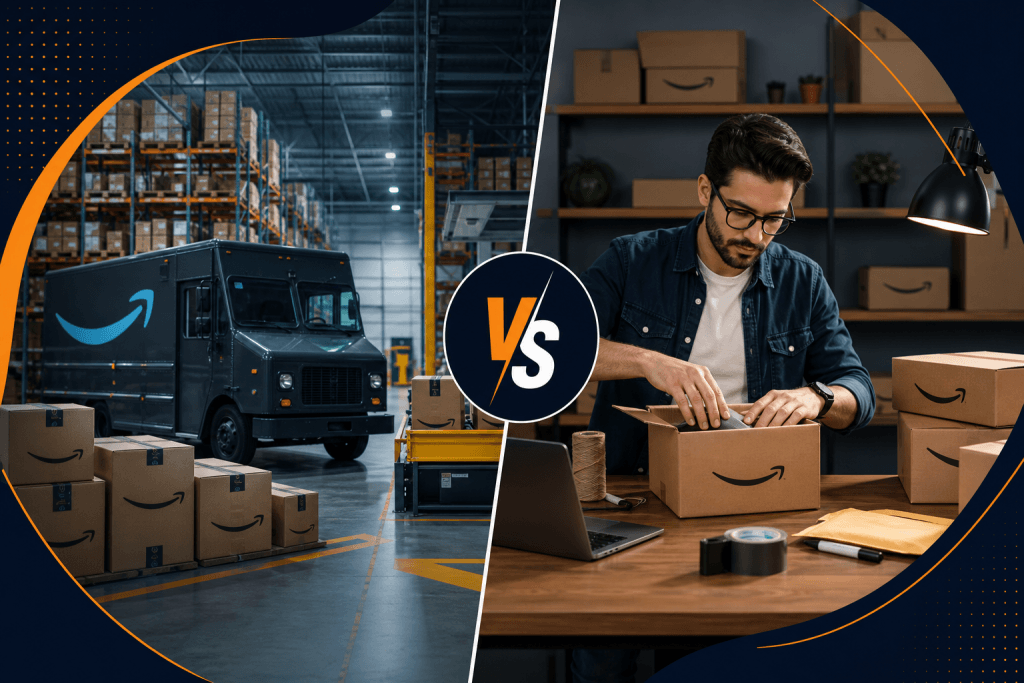
TL;DR: FBA (Fulfilled by Amazon) gives you Prime eligibility, hands-off logistics, and better organic ranking, but comes with higher fees and less control. FBM (Fulfilled by Merchant) offers more control, lower fees for bulky items, and flexibility, but requires you to manage shipping and sacrifice Prime badge competitiveness. Most sellers should use FBA as their primary model, with FBM as a strategic backup or for specific SKU types.
Table of Contents
- What Is FBA and FBM?
- FBA vs FBM: Fee Comparison for 2026
- When FBA Wins
- When FBM Wins
- Hybrid Strategy: Running Both
- How to Choose the Right Model for Your Business
- FAQs
- Conclusion
What Is Amazon FBA vs FBM?
Every Amazon seller must make a fundamental choice about how their products get from warehouse to customer. Amazon FBA (Fulfillment by Amazon) means you ship your inventory to Amazon’s fulfillment centers, and Amazon handles storage, packing, shipping, customer service, and returns. Amazon FBM (Fulfilled by Merchant) means you store your inventory yourself and ship directly to customers when orders come in.
This is not a one-size-fits-all decision. The right choice in 2026 depends on your product type, margins, business model, and growth stage. Both FBA and FBM have their place, and understanding when to use each is one of the most high-leverage decisions a seller can make.
According to Amazon’s 2024 Small Business Empowerment Report, approximately 90% of Amazon’s third-party sellers use FBA for at least some of their catalog. But “most sellers use it” doesn’t mean it’s universally optimal. Let’s break down exactly when each model wins.
Amazon FBA vs FBM: Fee Comparison for 2026
Understanding the cost structure of each model is foundational to making the right decision. Here’s a direct comparison for a hypothetical standard-size product selling at $30:
FBA Fees (2026, Standard-Size Example)
| Fee Type | Amount |
|---|---|
| FBA Fulfillment fee (small standard, ~1 lb) | $3.06 |
| Monthly storage (Jan, Sep, per cubic foot) | ~$0.78 |
| Monthly storage (Oct, Dec peak, per cubic foot) | ~$2.40 |
| Returns processing (if applicable) | $0, $5.40 |
| Estimated total per unit | ~$3.84, $6.50+ |
Amazon adjusts FBA fees annually (typically effective January 1). In 2026, Amazon introduced a modest increase to inbound placement fees for sellers who send inventory to a single location. Always check the current Amazon FBA fee schedule for the most current numbers.
FBM Costs (2026, Same Product Example)
| Cost Type | Amount |
|---|---|
| Shipping label (USPS First Class, ~1 lb) | $4.50, $6.00 |
| Packing materials (box, tape, mailer) | $0.50, $1.50 |
| Labor (pick, pack, ship at $15/hr + time) | $2.00, $4.00 |
| Returns handling | Variable |
| Estimated total per unit | ~$7.00, $11.50+ |
For a lightweight standard-size product, FBA is almost always cheaper per unit when you factor in the full cost of FBM shipping and labor. FBM becomes competitive for heavy, oversized, or slow-moving products where FBA’s size-based fees and long-term storage penalties make FBA cost-prohibitive.
When FBA Wins: The Case for Fulfillment by Amazon
Prime Eligibility Is Decisive
The single most important advantage of FBA is the Amazon Prime badge. In 2026, Prime has over 200 million global members, with US membership at approximately 180 million (Statista, 2025). Prime members spend an average of $1,400/year on Amazon versus $600/year for non-Prime shoppers.
When a Prime member searches on Amazon, they often filter by Prime delivery. Without the Prime badge (which FBA provides automatically), FBM sellers are invisible to a large segment of high-intent buyers. In most categories, losing Prime eligibility means conceding 30 to 50% of your potential audience.
Organic Ranking Advantage
Amazon’s A9 algorithm factors fulfillment reliability and Prime eligibility into organic ranking. FBA sellers, on average, rank higher than FBM sellers with equivalent reviews, prices, and sales velocity, simply because Amazon’s system rewards its own fulfillment infrastructure. This is not officially documented by Amazon, but is consistently observed and reported across the seller community.
Customer Service and Returns Handling
FBA means Amazon handles all customer service inquiries related to shipping and returns. For sellers managing dozens of SKUs or high order volume, this operational leverage is invaluable. The alternative, handling every “where is my order” email, processing returns, and issuing refunds manually, consumes enormous team bandwidth.
Scalability Without Headcount
As you scale from 100 to 1,000 to 10,000 orders per month, FBA scales with you automatically. FBM at scale requires warehouse space, staffing, shipping technology, and carrier relationships. Most sellers find that FBA’s per-unit fees are a bargain compared to the infrastructure cost of self-fulfillment at meaningful volume.
When FBM Wins: The Case for Fulfilled by Merchant
Oversized and Heavy Products
FBA’s fee structure penalizes large, heavy items. The fulfillment fee for an oversized item can easily reach $20, $75 per unit, obliterating margins on lower-priced products. For bulky items (large furniture, sporting equipment, industrial goods), FBM with direct freight shipping is often dramatically cheaper.
Slow-Moving or Seasonal Inventory
FBA charges long-term storage fees (LTSTFs) for inventory that sits in Amazon’s fulfillment centers for 365+ days. In 2026, the LTSTF is $6.90 per cubic foot for items stored more than 365 days. For seasonal products or items with unpredictable velocity, FBM eliminates this penalty entirely by keeping inventory in your own warehouse.
Custom or Handmade Products
Products that require customization, handmade assembly, or personalization cannot go through standard FBA. Sellers in this space must use FBM, which actually works to their advantage, as the handmade category customers often expect more direct communication with the seller anyway.
Business Continuity During FBA Disruptions
Amazon’s fulfillment network occasionally faces disruptions, natural disasters, peak-season backlogs, or inbound receiving delays. Sellers who have an FBM backup listing for their FBA products can switch fulfillment methods quickly and maintain sales through disruptions. This hybrid capability has saved significant revenue for multi-channel sellers during Amazon’s Q4 crunch.
Hybrid Strategy: Running FBA and FBM Together
Many experienced sellers run both FBA and FBM simultaneously for the same ASINs. Here’s how the hybrid model works:
- FBA listing handles the Prime customer base and high-velocity orders automatically
- FBM listing serves as a safety net when FBA inventory runs out, avoiding a stockout
- FBM listing can also serve international customers not covered by FBA internationally
- FBM pricing is typically set slightly higher to account for the higher unit fulfillment cost
Setting up a duplicate FBM listing alongside your FBA listing is straightforward in Seller Central. The key is maintaining this backup so that when FBA inventory runs low, you don’t lose the Buy Box entirely. Experienced sellers set up an automatic FBM backup for every major SKU during Q4 when FBA inbound lead times extend significantly.
How to Choose the Right Fulfillment Model for Your Business
Use this decision framework to determine FBA or FBM for each product:
| Factor | Lean FBA | Lean FBM |
|---|---|---|
| Product weight | Under 3 lbs | Over 10 lbs |
| Product size | Standard size | Oversized / bulky |
| Order velocity | High (50+/month) | Low (under 20/month) |
| Category competitiveness | High | Low (niche) |
| Inventory turnover | Fast (under 90 days) | Slow (90+ days) |
| Margin per unit | $10+ | Under $5 |
| Customization required | No | Yes |
Most sellers making their first FBA vs. FBM decision should default to FBA for standard-size products under 3 lbs with $10+ margins. Revisit the decision for each SKU annually as fee structures and product economics evolve.
Frequently Asked Questions
What is the difference between Amazon FBA and FBM?
FBA (Fulfilled by Amazon) means Amazon stores, packs, and ships your products and handles customer service. FBM (Fulfilled by Merchant) means you manage your own storage, packing, and shipping. FBA provides the Prime badge and better ranking potential; FBM offers more control and lower fees for oversized or slow-moving products.
Is FBA or FBM better for new sellers in 2026?
For most new sellers launching standard-size products, FBA is the better starting point. The Prime badge is critical for conversions in competitive categories, and FBA eliminates the operational burden of managing fulfillment while you’re building your business. FBM becomes strategically useful as your catalog expands to include products where FBA fees would erode margins.
Does FBM sellers qualify for Prime?
FBM sellers can qualify for Prime through Seller Fulfilled Prime (SFP), a program where you ship directly from your warehouse but meet Amazon’s Prime speed requirements (typically 1 to 2 day delivery). SFP requires meeting strict performance benchmarks and is generally only viable for sellers with robust logistics infrastructure.
What are Amazon FBA fees in 2026?
FBA fees in 2026 include a fulfillment fee (based on product size and weight, ranging from approximately $3.06 for small standard items to $75+ for oversized), monthly storage fees ($0.78/cubic foot Jan, Sep, $2.40/cubic foot Oct, Dec), and optional service fees for removals, returns, and inbound placement. Always verify current fees in Seller Central’s FBA fee schedule.
Can I switch from FBM to FBA?
Yes. You can switch any FBM listing to FBA by creating an FBA shipment for that ASIN in Seller Central. The listing will transition to FBA once Amazon receives and processes your inventory. Many sellers run both models simultaneously for the same ASIN as a hybrid strategy.
Conclusion
The Amazon FBA vs FBM debate doesn’t have a universal winner, it has context-dependent answers. Fulfillment by Amazon is the right choice for most standard-size, fast-moving products where the Prime badge, organic ranking advantage, and operational leverage outweigh the per-unit fee structure. Fulfilled by Merchant wins for heavy, bulky, slow-moving, or customized products where FBA’s fee model would compress margins to zero.
In 2026, the smartest Amazon sellers aren’t choosing one or the other, they’re running both strategically, using FBA as the primary engine and FBM as a safety net and cost optimizer for specific SKU types. Evaluate each product on its own economics, revisit annually as fee structures change, and build a hybrid approach that maximizes profitability across your entire catalog.
The team at Enso Brands manages fulfillment strategy for 200+ brands, from FBA cost analysis to hybrid FBA/FBM setups. If you want expert eyes on your fulfillment economics, we’re here to help.